Friday, May 29, 2009

road trip


My mom gave me her car. Which means I can sell my old car. Granted, it's a bit banged up and I don't expect to get more than $700 for it. But in the wee hours of this dewy morning, I have an epiphany.

I'm staring at the sidewalk, the dingy light of the street lamp tints the concrete the same color as a nicotine stain. "I'm going to drive north," I say out loud to myself. I look around because my voice doesn't seem to come from within me but more through me. Immediately my heart beats twice as fast and desire washes through my arms, down to my hands. There's that feeling, the one that fills me with a burning energy when I want to do something so badly. The passion that gives me the power to manifest, as if I just shot up some witch steroids. "As soon as I get seven hundred dollars together, my daughter and I are going on a road trip to Washington state." I'm smiling.

Wednesday, May 6, 2009

songs from WEEDS


Sunday, May 3, 2009

I Went Through the Language Rabbit Hole and Came Out a Feminist


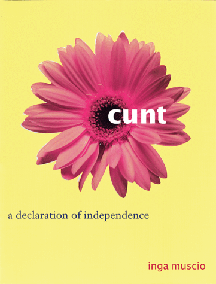
A classmate in my guitar class at Santa Monica Community College handed me the book. She told me that she thought it was the perfect book for me. I looked down at the little book in my hand. It was yellow, with a pink daisy on the cover. The title read, Cunt. A Statement of Independence. The author is Ingia Muscio, not anyone that I had ever heard of.

“Cunt?” I looked up at her curiously, “Really? This made you think of me?”

“You’re gonna love it.” She smiled into my eyes and walked out of the classroom. I looked back down at the book and wondered if she was hitting on me.

I flipped the book open to a page towards the beginning. It said, “Cunt is related to words from India, China, Ireland, Rome and Egypt. Such words were either titles of respect for women, priestesses and witches, or derivatives of the names of various goddesses.”(17). My immediate response was not of offense, but of awakening curiosity. I had always been interested in words since I found out that the root of the word, Lucifer, which is the name of the Christian devil, really meant, “bringer of light.” How could the name of the Lord of darkness mean bringer of light? Now I looked at this book and the same spark of curiosity ignited in my brain. How did empowering words for women evolve into the single most degrading word one can call a woman today? How did a word that denoted a degree of such respect as to be derived from the names of Goddesses, come to be profane? Why did a word that referred to a woman’s body part become the worst insult ever, anyway? Little did I know that this pink and yellow paper rectangle in my hand would awaken me to gender oppression, and incite me to empower myself and other women, something that I am so passionate about today, that I have become a women ’s studies major in college. I did not realize before reading this book that language carries with it so much power. I did not know how language has the power to shape culture. I did not know that dominant groups in society use language to oppress others. However, my most important realization was that I cared a lot about how language affects me, my daughter, and other women.

After I read this book I began to look up words in the dictionary to find their roots. Most dictionaries don’t have the word, cunt, but they do have the word vagina. In Cunt, Muscio writes that the root comes from words that mean priestess. When I looked up vagina, I was astonished to find that the latin root meant, sheath to a sword. I had to laugh but then I began to feel angry. Who decided that a woman’s body was created to be an ejaculatory capsule for a man’s sword? How could the men who have been in charge of shaping language for centuries ignore the simple fact that new generations of the human race are delivered solely through that specific space in a woman? A sheath cannot bring new life into the world. A sheath carries no mystery, no cycle, no power, and no respect. A sheath can only hold a sword. How offensive that the word that denotes respect for women becomes profanity, while the denigrating title becomes the accepted term. I was beginning to want to run out of the house and shout, “I love my cunt!”, or high five women in the street and tell them what beautiful cunts they are. I thought about how language affects me. How I’m reluctant to tell people that I’m a single mother, how I felt incomplete and like a failure for not making my marriage work. How the word, woman, denoted a specific role and destiny for me, and that destiny had to do with finding and making happy a man in my life.

Later I read an article from the book, Rape, Sex, Violence, History, and discovered how dangerous this definition of vagina was to women. In the late 1800’s, it was believed that a woman could not be raped. This was due to the, “vibrating sheath” (24). myth. Some crusty, old man had decided that women could vibrate their vagina in such a way as to render it impossible to penetrate. It was considered impossible to insert a sword into a sheath if it was moving around, and this was translated into the belief that if a woman claimed to be sexually assaulted she was lying, because if she really did not want it, she could have simply vibrated her sheath.

I realized then that this one word illustrates the general ideology that women exist only to please men. I began to see in my daily observations of human interaction how both men and women contribute to the perpetuation of this ideal. The language that I had been using in my daily life needed to be examined. All words became subject to my growing suspicion that our language was indeed androcentric, or centered around men, and that this served to oppress women throughout history and in modern day. Why is history, history, anyway? Could this be why the stories that have been passed down from generation to generation in this country are stories about men and their conquests? Was there a herstory? Are the stories and accomplishments of women rendered inconsequential and invisible?

Why are men just men, or male, antonymous and independent? We are women or female, words whose roots mean “of men” or “from men”. I haven’t seen any men birthing any babies, so how are women from men? The race of people on this Earth is currently referred to as mankind or human. There is no word that illustrates the contribution that women have made in this world. None at all. I began to reexamine words used to insult men and found out that they were actually insults against women. The word bastard or son of a bitch are both words to describe a man who is a bad person, or a mean person, yet they are both insults against that man’s mother. This implies that the mother is the reason behind the man’s personality flaws. I wondered if insults like this reflect the general idea that being a single mother is bad, which may be why my cousins are always trying to reassure me that I’ll find another guy. It never occurs to them that maybe another guy is not something I want.

In the American Heritage dictionary, I looked up the word, mensus, another word centered around men, used to describe a biological process that is purely female. The definition said that the mensus is debris that is ejected out of a woman’s vagina. This reminds me of the attitude that boys would take towards a woman’s cycle, a very immature attitude. I remembered my first menstrual cycle; I was 13, on a class trip in New York City. I remember locking myself in the bathroom, reading the directions off of a tampon box, terrified that the curious and snickering boys in my class would find out my terrible secret. In a society where people didn’t define this process as a bloody mess of trash leaking out of my body, maybe my experience, and the experience of many other girls, could have been much better. Yet again, I had found another example of how language had intimately and profoundly affected my own life.

As a child, I often heard the rhyme, “Sticks and stones may break my bones, but words will never hurt me.” In actuality, I learned, and continue to still learn, how words actually contain the power to shape society and our own personal lives. Words can even be used as weapons, covertly used by dominant groups in society to divide and label people for their own benefit. Other groups are stigmatized and marginalized because of this, and women are not the only victims. Racism, sexism, classism, heterosexual privilege, ableism, and ageism are the dark and bloody waters of which many of the words we wield so casually today were born from. It was not until I picked up that little yellow book with the pink daisy on it that I was awakened to this, and to myself. Today I am a gender and women’s studies major, with a passion for deconstructing these notions and reshaping language to represent and empower everyone. I carry that little book with me, and one day I am going to hand it to another woman, smile into her eyes, and say, “You know, I saw you and I think this book would be perfect for you…”

Wednesday, April 29, 2009

summer lovin'


Today I wake up feeling inspired about my path for this summer cycle. My semester ends May 14 and I’m ready to stop putting all of my energy into my brain and begin to give to my body and my spirit. I found out that I can fulfill my GAIN requirement (32 hours per week of “gain approved activity” and staying home with your child over summer break is not one of the options) by volunteering! That means that I can get paid child-care to do volunteer work. Now when in my life am I going to be in a position to do that if not now? Even if I did get a mind numbing job slinging lattes for assholes, I would be making not much more than I get in public aid and my “welfare clock” would still be ticking. Besides, working in the non-profit sector would allow me to network and learn from the people who know how to run non-profits! Imagine if I could write a grant proposal to get the funds to buy some property and build a straw-bale, sustainable and healing in a holistic way type of assisted living facility for people who have low-socioeconomic status! I might even be able to use the experience to credit one of my independent studies that I have to do next semester. I’m thinking of volunteering at the LGTBQ center in WeHo and the Hollywood chapter of NOW. Hmmm. I wonder if service learning weekends at the perma-culture ranch in Santa Barbara would count. I’ve already made my “volunteer resume.”
The other thing that I want to do is be in my body. In the middle of the school semester, I really lose that and I let myself live in my brain while my body eats donughts. Well, now that I have terrible allergic reactions to bread, I won’t be eating donughts, or pizza, or cheeseburgers. I want to eat delicious foods that look beautiful and nurture my body while giving me pleasure. I see myself sipping the milk out of a coconut while eating raviolis made out of thinly sliced radish and filled with macadamia butter. I want to switch my coping mechanism of smoking Parliments to breathing. Yes, just breathing. Yoga, walking on the beach, hiking, kravmaga, swimming, and biking are going to take up hours of my day. I’m going to talk to my body, be in my body, celebrate my body, give love to my body, and get the exercise I need to feel healthy and balanced. Not to mention have the opportunity to connect to nature on a daily basis. One of the wonderful things about California is that one gets the opportunity to turn their back on the city and experience the nurturing land and ocean just by doing a 180.

Which brings me to nurturing my spirit. My spiritual practice has been pretty much null lately, except I do still bless myself in the shower and pray to the parking Goddess every day. This summer, I want to care for a little herb garden on my front porch, I want to play my guitar in the sun and learn all of the songs that make me feel really light when I sing them. I want to buy a “writing hat”(maybe one like old country blues musicians wear?) and go to unusual places where I can drink coffee and type all of my memories and stories and character makeups into my little, black computer, or read all of my favorite authors. In fact, I want to spend just as much time writing and reading for pleasure as I do being in my body. But I never want to write at home, I always want to go somewhere and write. Anyplace would do, a coffee shop, a dive bar, under a tree, in front of a museum. It will be an adventure.
Even further I want to ritualize everything. Especially the mundane. How do I make doing laundry magickal? Could I fold extra love and protection into my kid’s clothes? On the full moons I want to hike in the mountains; on the new moons I want to create astral temples and vision boards. I want to pretend that I’m on vacation all of the time, and go see all of the things in L.A. that tourists see and I take for granted. I have never taken my picture in front of Grommes Chinese with those cement hand and foot prints of old time Hollywood stars. I think it’s time.

Thursday, April 23, 2009

The New Wave of Feminism is Leaving Campuses and Infiltrating the Web

In the past few decades, feminism has spread across many of the Universities around the country. Many colleges now have a Women’s Studies department, and one can find classes on feminist theory, history and methods. Even academic research has changed due to feminism. Feminism has affected every aspect of our academic lives, including the language we use, as well as how we gain social knowledge. Today, a new wave of feminism is building, and it is off of the campus and in the internet in the form of blogging. This expansion of feminist knowledge out of academia is crucial to the movement in this day and age where information technology is booming. Blogs not only serve feminist research practice by providing immense qualitative data from many marginalized walks of life, but also changes the language of feminism from that of academia to a language that is accessible to many other people who are not scholars or go to college.


Furthermore, blogging eradicates most discrimination when it comes to free speech as most people from any economic background can have access to this free form of publishing. And there are no stipulations about race, sex, class, sexuality and other aspects that can bar someone from writing a blog. Absolutely anyone who can read and write and has access to a local library’s internet is able to have a blog. As a forum for debate, a blog can be more critical than a campus debate because there are no speech codes enforced on the argument. Speech codes are campus guidelines for acceptable speech on campus. The reason that these codes can represent a threat to free speech is the simple question of who gets to decide what indeed acceptable speech is. In the blogging forum there are no codes, rules or guidelines that one must adhere to in order to speak. Even if one is extremely offensive, they cannot be silenced in this particular forum. This no holds bar freedom of speech within the blogosphere is what makes blogging so powerful. One can go on the internet and read almost every point of view, from the ultimate religious conservative to the anarchist prostitute.


Before, social scientists placed primary importance on quantitative research, that is, research that is numerical at its base, can cover a large number of people, and be generalized to a certain group. This type of research comes from a sociological scientific ideology called positivism, where information that is considered social fact must be collected from a purely objective, non-biased, value free researcher. However, women have found that fitting knowledge about women into this paradigm only served to subjugate us further. We know now that the view of positivism in the academic, social science arena is not unbiased at all, but comes from the perspective of the dominant group in society who created and presided over the field for so long. Namely, those with sex, race, heterosexual, ability, and class privilege. In Feminist Research Practice, Sharlene Nagy Hesse-Biber and Patricia Lina Leavy insist that, “…feminist disciplinary goals…aim to avoid hierarchies and unearned privileging of quantitative methodologies” (276). Quantitative research alone does not serve to illuminate the experiences of the marginalized, invisible and oppressed groups. Secondary to quantitative research is what is called qualitative research. This is research that is not about numerical data but focuses more on the experience of the individual in a certain group through involved interviews with that person. Feminists were worried that quantitative research leaves out the whole story and has the ability to misrepresent women and girls in the research findings. We know that research conducted on women and girls can profoundly affect their lives, and the feminist goal in research is not to do research “on women and girls but for them.”(250). To put women, girls, and other marginalized groups in the center, a new way of gaining knowledge is critical. Feminism helped launch the acceptance of a different type of research, one that does not value numbers or generalizations but instead places critical importance on the thoughts, feelings, language and daily experiences that an individual goes through in their life. This is called feminist standpoint research, and is very important to feminist epistemology, or how we gain knowledge about women and other oppressed groups. According to Feminist Research Practice, “Feminists, in contrast, give priority to actors’ own subjective experience and emphasize the emotional aspects of social life grounded in concrete, daily experiences. For them, data must be qualitative in order to reveal these aspects.”(268). Because all forms of sharing experience are valid in this methodology; poetry, art, journaling, music and much more are now all accepted forms of knowledge. Blogging is no exception.


We may be familiar with the old, childhood rhyme, “sticks and stones may break my bones but names will never hurt me.” As a feminist, I hold this to be false. Language is very important in shaping social ideology, which in turn shapes social policy, and even our face to face encounters with our associates, friends and family. Rosalie Maggio writes in her essay, Bias-Free Language: Some Guidelines, that, “Language goes hand in hand with social change – both shaping and reflecting it. Sexual harassment was not a term anyone used 20 years ago; today we have laws against it. How could we have the law without the language?” (471). In this quote, Maggio illuminates the importance of bringing the language of feminism to the average person and how this language has had a profound effect on our laws and our lives. To this day, the word feminist is subject to misunderstanding, due to the media backlash against it that started in the 1980’s. Today, that can be repaired if the word feminist is normalized and has widespread recognition. If feminism is really for everybody, as I firmly believe that it is, it needs to be presented in a language that everyone can understand. Because of the wide reach of the internet into the homes and minds of so many, blogging can be the antidote to the feminist backlash that we still suffer from, as well as bring the language of gender equality into the everyday lives of many people.


Another reason to take feminism to the blogosphere is to separate feminist writing from political rhetoric, a form of writing that George Orwell, author of 1984, believes is designed to, “…even think your thoughts for you…” (210). Political writing in the form of propaganda is given very little respect in some corners of the literary community and has been described by Orwell in Politics and the English Language, as, “the enemy of truth and the cause of linguistic degeneration…that endanger free thought and truth…”(204). Even though feminist blogging could indeed be political, feminist writers seek to deviate as far away as possible from stereotyping, biased language, and exclusionary language. The type of language that Orwell describes as, “ugly and inaccurate…[and] makes it easier for us to have foolish thoughts.” (205). If people are swayed to embrace equality and compassion from a blog, it is not because of a savvy political writer’s ability to wield euphemisms, glittering generalities, and gobbleydegook. These are all forms of propaganda that purposely ignites our emotions in order to control our thoughts and come with many logical fallacies. This is not the language of feminism. From a feminist perspective, empowerment has come from refusing to be silent, sharing knowledge with other women, and naming those things that oppresses us as well as uplifts us. Never does it come from manipulating the thoughts and feelings of others.


The argument against blogging is the same as the reason why it’s so powerful. That anyone and everyone can blog and that there are no rules and regulations to control it. Opponents of feminist blogging believe that the information cannot be trustworthy because it does not come from academic sources. I believe that this view is biased towards scholars and de-values people who may not be college graduates. I do not believe that anyone should be disregarded because of their academic status, or lack of it, just like I do not believe that people should be de-valued for their economic status, race or gender.


Some feminists still oppose blogging, believing that women should be out on the streets creating social change, instead of wasting their time writing about whatever they deem interesting at the moment. But even those who oppose blogging have their own blog. One woman, who goes by “Mother Jones,” writes on her blog that, “Today's feminists need to blog less and work more. If women want reproductive choice to remain more than rhetoric, they'd better stop assuming these clinics will be there when they need them… OK. Tell me exactly what today's feminists are doing for the struggle.”


In response to her post, another woman blogger who calls herself Holly, writes, “I am often asked what I am doing for feminism and what I tell them is that I blog. I share my feminist ideals on my blog and encourage educated and informed conversations on a wide range of topics that matter to me, to humans, and to my feminist activism. Many people don’t think that blogging is enough, but if you read the bulk of feminist, womanist, and humanist blogs out there, most of the topics that are brought up for discussion come directly from living life and being a humanist out in the big, sometimes cruel, always controversial world.”


This exchange of ideas between feminists is very important if we are to unify ourselves to create social change. There are numerous debates within the feminist community that take place in various feminist blogs. It is critical that this dialog happen if the movement is to evolve and become successful in diversifying and including all women from all walks of life. Because of the ability to get the point of view of so many different types of women, the feminist movement itself is better at being inclusionary to all of us through blogging. Those voices that have been previously invisible in a movement that was predominantly white and of upper middle class can now be heard. Women of color, lesbians, girls, sex workers, house wives, immigrant mothers, single mothers, transgendered women, disabled women, welfare recipients, and too many others all now have a better chance at getting their stories heard and their troubles addressed. In this day and age, diversifying, not homogenizing our numbers in the feminist movement is key to accomplishing the social change that we so adamantly want in our lives and in the world in general.


Consciousness raising has been a tool of the feminist activist since the first wave. Historically, it is how the feminist movement began. Many times this was done by getting a group of women physically into a room together so that they could talk to each other and share their individual experiences which serve to illuminate the oppressive forces in society. The blogosphere is a virtual room where consciousness raising is taking place on an international level, 24 hours a day.
Feminism has needed a vehicle to take it out of the universities and into the everyday lives of people in order to be successful. Because of technology, blogging is that vehicle. Not only is it bringing the language of gender equality and humanism in general to the masses, but it is also changing the way we gain knowledge about women and girls. Most importantly, the stories, feelings, thoughts and experiences of women and girls from all walks of life and all over the world are accessible to the masses. The voices of the marginalized no longer have to be invisible, and we have the ability now, with blogging, to see the many different perspectives that are presented, not just what mainstream media decides to feed us. For the feminist movement, blogging can be the way to expand, diversify, dialogue and gain insight in order to create social change that benefits women, girls, and other oppressed groups. Feminism has escaped the bars of academia, and we can now share our language with the masses, thanks to the medium of blogging.

Works Cited
"Blogging - the future of the LGBT movement? " Between the Lines [Livonia] 11 Dec. 2008,8.
GenderWatch (GW). ProQuest. California State University, Northridge. 19 Mar.
2009 http://www.proquest.com/
Hesse-Biber, Sharlene Nagy, and Patricia Lina Leavy. Feminist Research Practice A Primer.
Minneapolis: Sage Publications, Inc, 2006.
Holly. "Blogging is activism." Weblog post. Menstrual Poetry. 14 Mar. 2009. 4 Apr. 2009
.
Johnson, Robert "KC", and Ralph E. Luker. "Who's Undermining Freedom of Speech on
Campus Now." Exploring language. By David Beito. New York: Pearson Longman,
2007. 520-22
Liz Newbury. . "NOW Brings Feminist Voices to the Web, Engages Women Online. " National
NOW Times 1 Oct. 2008: 6,11. GenderWatch (GW). ProQuest. California State
University, Northridge. 19 Mar. 2009 http://www.proquest.com/
Maggio, Rosalie. "Bias Free Language: Some Guidlines." Exploring language. New York:
Pearson Longman, 2007. 470-79.
Mary Cartledgehayes. . "Isn't It Time You Created a Blog? " Today's Woman 1 Nov. 2008: 48-
51. GenderWatch (GW). ProQuest. California State University, Northridge. 19 Mar.
2009


Orwell, George. "Plitics and the English Language." Exploring language. New York: Pearson
Longman, 2007. 204-14.

Thursday, April 16, 2009

Oh Lordisa am I hung over

I remember typing when I got home last night but I just re-read what I wrote. I think I like writing shit faced!

I dreamed last night that I was back at the bar and I had to pee really bad. I went into the bathroom stall but for some reason i chose to pee on the floor instead of in the toilet. As a river flowed from my stall into the others, all the women in the bathroom got very angry at me for peeing on the floor and I had to run out of the bathroom with my jeans still around my ankles. I then found a corner of the bar and peed there instead. My parents came into the bar and I told them that they had to drive me home because I was too drunk. They refused! I told them they were useless.

My first national publication

In the July issue of HUSTLER magazine, you will find an article by yours truly in the "college report" column. My first national publication and the first publication that I have actually been paid for. I just received a check in the mail signed by Larry flynt! It's pretty cool.